Open · Revenue share
You Already Own the Room. Now Earn From It Monthly.
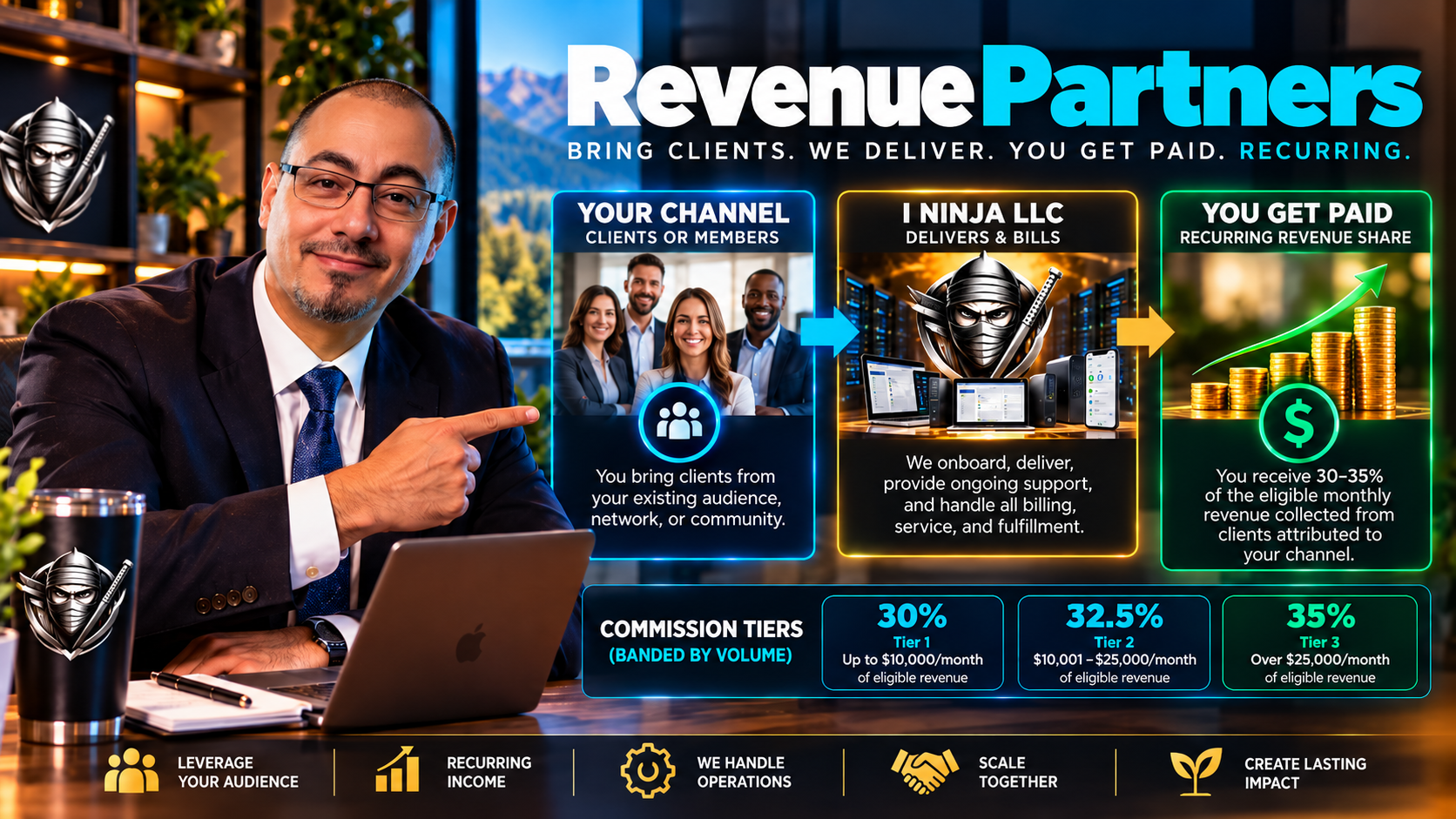
Revenue Partners is for people who already have the room: an agency with a client base, a consultant with a book, an association with members, an audience that listens to you. You introduce the channel rather than chase accounts one by one. I Ninja LLC delivers the work and bills the client, and you earn thirty to thirty five percent of what that channel collects, depending on volume, for as long as those clients stay.
The arrangement in one screen
What is actually being proposed.
Partnership is a word people use to avoid describing the deal. Here is the deal.
-
You bring a channel, not a lead
-
I Ninja LLC delivers the work
-
I Ninja LLC bills the client directly
-
You earn a recurring share of collected revenue
-
Thirty to thirty five percent of eligible collected revenue
-
Nothing to buy
-
I Ninja LLC owns the client accounts
If any of those seven lines is a problem, it is a problem now rather than after a quarter of introductions.
Choosing correctly
This or the Sales Representative role. They are not the same thing.
Most people who land here belong in one of these two and not both. Picking the wrong one wastes a conversation, so here is the honest difference.
Sales Representative
You sell account by account. Each client is a separate conversation you open, work and close yourself. Twenty percent of eligible collected revenue per attributed client, recurring while they stay.
Right for you if you are an individual seller with relationships you work one at a time, and you want to start this week without a commercial negotiation first.
The full role and the terms
Revenue Partner
You introduce a population, not a prospect. One agreement opens a client base, a membership or an audience, and accounts come through it over time rather than one at a time.
Right for you if you already own the trust of a group of businesses, your name is attached to the recommendation, and the volume justifies agreeing terms before anything starts.
The tradeoff is real: the rate is roughly half as much again as the representative rate, and your reputation is in it in a way a representative's is not.
If you are genuinely unsure which you are, say so on the call and I will tell you plainly. I would rather route you correctly than sign you into the arrangement that pays me more.
Economics
How the share actually behaves.
It is an override on collected revenue
Your share is calculated on the eligible monthly package revenue actually collected from clients attributed to your channel. Not on contracts signed, not on proposals sent. A client who signs and never pays produces nothing for either of us, which keeps both our incentives pointed at clients who stay rather than clients who close.
Thirty to thirty five percent, banded by volume
That is the range, and it is published here rather than held back for a call, because a number you have to extract from somebody is a number that is about to be negotiated against you. Where you land in it depends on the volume the channel produces. For comparison, an individual sales representative earns twenty percent, so a partner is earning roughly half as much again on the same collected revenue.
The specific percentage and the volume bands are agreed in writing before the first introduction, not discovered afterwards. A partnership where the economics get settled retroactively is not a partnership, and the sequence matters more than the number.
It recurs, and it does not require you to keep producing
The share continues for as long as those clients stay active, receive eligible services and keep generating collected revenue. There is no monthly volume you have to hit to keep what you already introduced. If your channel goes quiet for a quarter, the accounts already in it carry on paying.
It follows the client in both directions
When a client in your channel upgrades, your share recalculates against the higher eligible revenue, including when the upgrade happens without you in the room. When a client reduces services, it recalculates down. The second sentence is the one most partner programs leave out, which is exactly why it is in the same paragraph as the first.
The accounts are mine. The payment right is yours.
I Ninja LLC holds the client accounts, the service agreements and the client information. What you hold is a contractual right to a share of the revenue those accounts collect. That is a real limit and you should weigh it: it is not a book of business you could sell, and the revenue share right cannot be commercially transferred to a third party.
I would rather say that plainly than let a partner spend two years assuming otherwise. If owning the client outright is the thing that matters most to you, this is the wrong arrangement and there is no version of this page that changes that.
There is no cap, and no floor
I do not put a ceiling on partner earnings. I am also not going to imply that the absence of a ceiling is a forecast. What a channel produces depends on its size, its trust and what those businesses actually need. No minimum revenue and no result is guaranteed, and anybody who gives you a projection for your audience has not met your audience.
The shape of a good channel
Six kinds of partner this tends to fit.
The common thread is not industry. It is that a group of business owners already takes your word for something.
You already serve these businesses
Marketing, creative and digital agencies with a retained client base. Your clients already ask you why the leads you generate are not being answered. This is the answer, and it is not one you have to build.
You are already in the operations
Operations, growth and management consultants who are inside the business and can see the bottleneck. You are usually the person who has to recommend a tool anyway. This way the recommendation pays.
You have members, not customers
Trade associations, franchisors, buying groups and professional networks. A member benefit that solves an operational problem is worth more than a discount code, and it recurs.
Business owners listen to you
Podcasters, newsletter writers, course creators and community operators whose audience is owner operators. Your audience is the asset. This is a way to earn from it without selling it something disposable.
You serve the same buyer, differently
Bookkeepers, IT providers, insurance organizations and anyone else already trusted by the same owners. You are not competing with this, you are filling the gap your clients complain to you about.
You run several of the same thing
Groups, franchise operators and owners of multiple locations or brands. You can run it across what you already own and extend it to the operators around you.
Read this before the call
Your reputation is the collateral, and that is a real cost.
A sales representative who recommends something that disappoints a client loses a client. A partner who recommends something that disappoints their audience loses standing with the whole audience. Those are not the same risk and I am not going to pretend the second one is covered by a better percentage.
That asymmetry is the entire reason the delivery side is built the way it is. There is live chat and video support staffed around the clock, recorded platform training and walkthroughs, and dedicated onboarding teams who take each new client through setup. Jerrica Coyle and I lead the build and the strategy directly, so a problem in your channel reaches a person who can change something rather than a queue.
I would still rather you test it than trust it. Bring me two or three clients from your channel before you announce anything to the rest of it. If the delivery does not hold up, you have risked three relationships instead of your reputation, and you will have found out something true about me at a price you can afford.
Any partner who is not willing to start small is telling me they have not thought about what happens if I am wrong.
What sits behind you
You should be making introductions, not running a second business.
- Delivery, start to finish. Build, configuration, onboarding and ongoing service. Your channel does not become your support desk, and you are not in the middle of a setup call explaining something you did not build.
- Billing and collections. I Ninja LLC invoices the client directly. You are not chasing payment from people who trust you, which is the quiet way these arrangements destroy relationships.
- Twenty four hour support. Live chat and video support, recorded walkthroughs of every feature, and onboarding teams for new clients.
- Material shaped to your channel. If your audience needs a different funnel, a different presentation or a different entry point than the general one, bring it and we adapt it. A message built for everybody converts for nobody.
- Proof you can point at. Live client sites, forty-two named testimonials and public Google reviews on two business listings. You are not asking your audience to take your word alone.
- App access under the program. So you are recommending something you actually use rather than something you have only been shown.
- A direct line. You deal with me and with Jerrica, not with an account manager who has to ask somebody else before answering you.
The question everybody has
Six things this is not.
Anybody with an audience worth partnering with has been approached by something that looked like this and turned out to be something else entirely. You are already running that check in your head, so I will save you the trouble.
- Not multi level marketing. You earn nothing from recruiting other partners, and there is no downline of any kind.
- Not a franchise, a licence or an investment.
- Not pay to participate. There is no partner fee, no onboarding charge and no minimum purchase, at any point.
- Not an affiliate link paying a one time bounty on a signup.
- Not a white label arrangement. I Ninja LLC owns the accounts and bills the client, and I am not going to blur that to make the page more attractive.
- Not exclusive by default. If your channel needs category or territory exclusivity, that is a conversation to have openly rather than a promise this page makes to everybody who reads it.
Real services, sold to real businesses, with a share paid out of revenue those businesses actually pay. The model is plain enough to describe in one sentence, which is usually the test.
Starting
One call, and nobody is going to pitch you.
This is a commercial agreement rather than an application, so it starts with a conversation about whether your channel and this offer actually fit each other.
Tell me three things when you get in touch and the first call will be worth having:
- Who is in your channel. Roughly how many businesses, in what industries, and what is your relationship to them.
- What they already complain to you about. That tells me faster than anything else whether this fits.
- What you want the arrangement to do for your business, and whether you want to be involved in delivery at all.
Book the fifteen minute call and say it is about Revenue Partners. It is the same calendar I use for everything else, so do not worry that you have landed in the wrong place, and it is free. If you would rather write first, use the contact form or email ianl@i-ninja-llc.com.
If it looks like a fit on that call, the next step is a walkthrough of the platform so you can see exactly what your channel would be getting before you put your name near it. Both calls are free and neither one ends in a pitch.
Read the full program terms before the call if you would rather come to it already knowing the structure. Terms are agreed in writing before any introduction is made, so if the numbers do not work for you, that is a reasonable place to stop and it costs you one conversation.
Straight answers
What partners ask first
What percentage do Revenue Partners actually earn?
Thirty to thirty five percent of the eligible monthly revenue collected from clients attributed to your channel, banded by volume. An individual sales representative earns twenty percent on the same revenue, so a partner is earning roughly half as much again. Where you land in the range depends on what the channel actually produces, and the specific percentage and bands are agreed in writing before you introduce a single client rather than settled afterwards.
Can I put my own brand on it and resell it myself?
Not under this arrangement. Revenue Partners is a revenue share, which means I Ninja LLC delivers the service, bills the client and holds the account, and you earn a recurring share of what is collected. If what you actually want is to buy at wholesale, set your own price and own the client outright, that is a different conversation and I would rather you ask for it directly than try to bend this into that shape.
Do I have to stop doing what I already do?
No, and most partners should not. This is designed to sit on top of an existing agency, consultancy, association or audience rather than replace it. There is no exclusivity requirement and no demand that you drop other services. The one thing I would ask is that you are straight with your channel about the fact that you earn from the recommendation, because an audience that discovers it later is an audience you have lost.
What happens to my share if a client cancels?
It stops for that client, because the share is paid on revenue actually collected and there is no revenue to share once they leave. Your other accounts are unaffected. I would rather be clear about that than let you build a plan on the assumption that a cancelled client keeps paying you. The accounts that stay are the ones that matter, which is why the delivery side is built the way it is.
Is this multi level marketing?
No. There is no downline, no recruitment commission and nothing sold to partners. You earn from one source only, which is a share of revenue collected from businesses buying services they use. Nobody pays a fee to become a partner, and no part of your earnings comes from bringing in other partners. I understand exactly why the question is asked of any revenue share arrangement and I would rather answer it than dance around it.
How small can a channel be and still be worth it?
Smaller than most people assume, because the share recurs. A consultant with a dozen genuinely engaged clients can be a better partner than somebody with a mailing list of thousands who do not open it. What matters is whether those businesses would act on your recommendation, not how many of them there are. If you are unsure, describe the channel honestly on the call and I will tell you whether I think it works.
Important: Revenue Partners is an independent commercial arrangement and not employment. No salary, employee benefits, guaranteed revenue or minimum result is offered or implied. Revenue share is calculated on eligible collected monthly package revenue. Rates, client attribution, payment schedules, term, termination, post termination payments, exclusivity if any, and all other conditions are governed by a written partner agreement, which controls if anything on this page differs from it. I Ninja LLC retains ownership of all client accounts, service agreements and client information. Independent contractor status is subject to applicable law. Nothing on this page is an offer, a projection of earnings or a guarantee of any outcome.
Next step
Describe your channel. I will tell you honestly if it fits.
Including when the answer is that it does not. Routing somebody into the wrong arrangement costs me more than the conversation is worth.