I Ninja LLC
I Built This Because I Was the Bottleneck.
Every inquiry, every booking, every follow-up and every awkward payment conversation ran through me. I could not get sick, could not take a week off, and could not grow past my own calendar. Nothing I bought fixed it, because the tools were never the problem. The problem was that none of my process existed anywhere except in my head.

Why it exists
Buying more software is how most owners make this worse.
The usual path is to add a tool for each symptom. A scheduler because booking is painful. Something else for texts. A third thing for review requests. Each one solves its slice and none of them talk to each other, so now there are five logins, five bills, and five places a customer can fall through. The work did not go away. It got distributed.
What actually changes things is writing down how your business really operates, deciding which parts genuinely need a person, and then building the rest so it happens on its own whether or not anyone is at a desk. That is unglamorous, it takes longer than installing an app, and it is the only thing I have seen work.
What it actually is
Two parts, working as one.
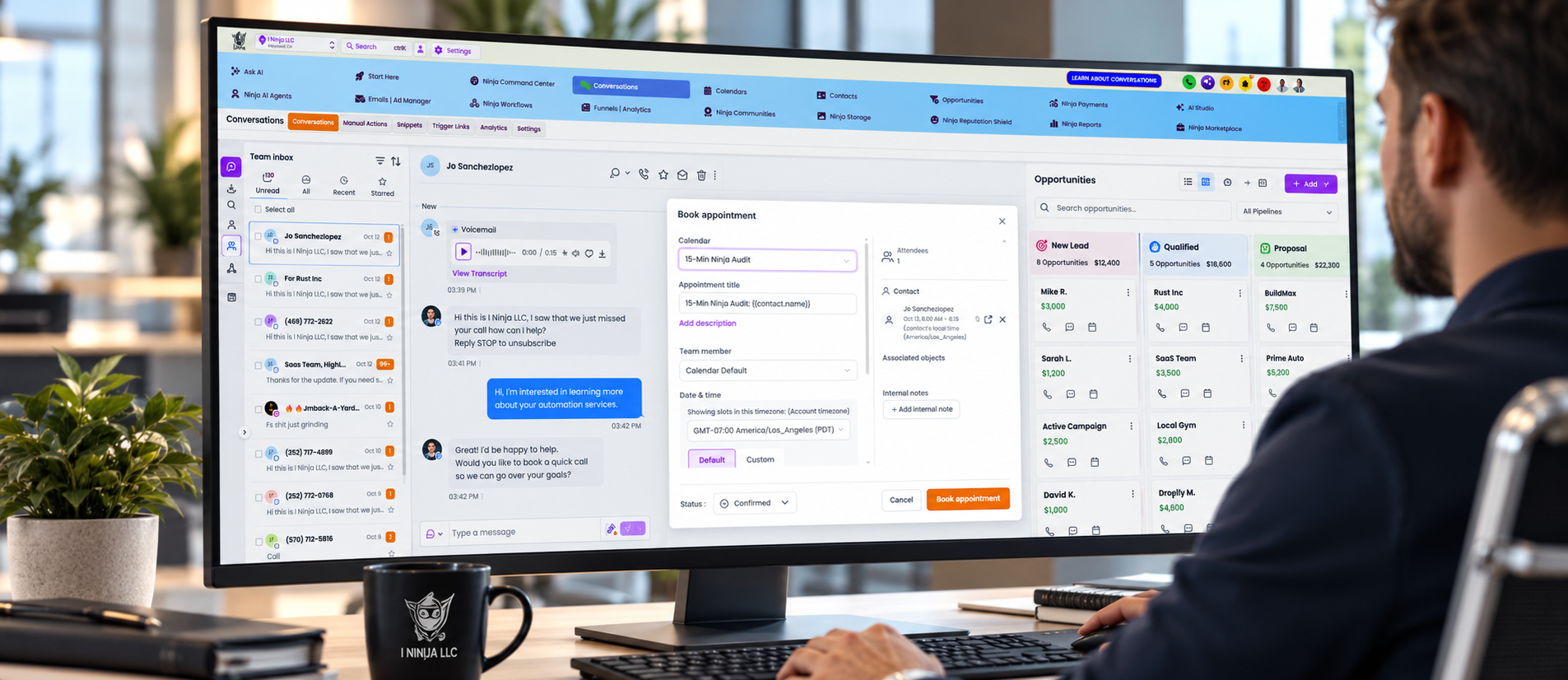
An AI Ninja Employee that handles the conversations and the chasing, and the I Ninja App where all of it lives, gets tracked and gets paid for. Nine services sit inside that, and most businesses do not start with all nine.
Messaging, Webchat and AI Voice
Texts, web chat and calls in one thread per customer instead of scattered across devices and people. The voice assistant picks up what would otherwise be a missed call, which for most service businesses is the single most expensive thing that happens all day.
AI Follow Up and Automated Workflows
The sequences nobody has time to run by hand, in your wording, stopping the moment somebody replies. This is also where old leads get worked, the ones already paid for that nobody has contacted in a year.
Automated Booking
People book into real availability instead of trading messages to find a slot. Reminders go out beforehand, which costs nothing and quietly prevents a good share of the no-shows you currently absorb.
Reviews and Listings
Review requests sent as part of the process rather than when somebody remembers, and business listings kept accurate so the phone number people find is the one that still works.
Payments
Getting paid in the same place the conversation happened, rather than sending somebody off to a separate system and hoping they come back to finish.
The infrastructure, when it is needed
Networks, machines, servers and independent local AI machines that keep your data in your building. Most jobs never touch this. The ones that do are the ones nobody else will take.
The part most vendors will not say
Seven of the nine services have no AI in them.
AI is a component here, not the product. Messaging, follow-up, workflows, booking, reviews, listings and payments all run perfectly well on your own words, your own rules and your own process with nothing clever involved. Exactly two are AI by definition, the AI Voice assistant and the AI web chat, and if you do not want those you simply do not take them.
I say this because the industry currently has it backwards. Plenty of what gets sold as artificial intelligence is ordinary automation with a new label and a higher price, and plenty of owners are being talked into technology they neither need nor trust.
What it is not allowed to do
- It does not record calls. Written summaries only. Nobody wants their customers recorded, and no owner wants that sitting on a server somewhere.
- It does not decide anything about money. Not pricing, not discounts, not what you pay people. Those stay with humans, permanently, and no amount of convenience changes that.
- It does not improvise. It says what has been approved in advance. If a conversation goes somewhere it was not set up for, it hands over to a person rather than inventing an answer.
Who it fits
Businesses where revenue depends on conversations.
If a missed message costs you a job, this is built for you. If you sell something off a shelf and nobody ever calls, it probably is not.
Staffing and recruiting
Candidates and clients both go cold fast, and both conversations are running at once.
Property management
Showings, maintenance requests and renewals, all of it time sensitive and all of it repetitive.
MSPs and IT services
Where I come from. Ticket intake and client comms, from somebody who has run the wires.
Agencies and consultants
Usually brilliant at delivery for clients and dreadful at the same process internally.
Insurance agencies
Enough of its own rules to need a purpose-built version.
Local and professional services
Trades, clinics, firms. Anywhere the phone ringing is the business.
How a build runs
Four steps, and no giant rebuild of your business.
- Find the bottleneck. Not a list of everything wrong. The one thing costing you the most, which is frequently not what you came in thinking it was.
- Build that system. Around how you actually work rather than around a template, with your language and your rules in the middle of it.
- Automate the repeatable part. Only the part that genuinely repeats. I will tell you which steps should stay human, and there are always some.
- Improve it over time. The first version is never the last one, because businesses change and so do the tools underneath them.
Whatever gets built is written down in language your team can follow, and it is yours. That matters more than anything else on this page: if a vendor cannot hand you documentation of what they built, what you bought was a dependency on them.
Straight answers
What owners ask before they start
Do I have to replace the software I already use?
Usually not all of it, and I would be suspicious of anybody who says you do. Plenty of businesses have one or two tools that work fine and a pile of others that overlap. The audit normally finds you are paying for three things that do one job between them. Where something you own already does the job properly, keep it and we connect to it. Where you are paying twice, you stop.
How much of my own time does this take?
More at the start than you would like and far less afterwards. The part only you can do is explain how your business actually works, including the bits that live in your head and have never been written down. That is a few conversations, not a second job. Build and configuration are ours. The owners for whom this does not work are the ones who cannot spare any time at all to explain the process, which is usually a sign of how badly they need it.
What happens if I want to leave?
You take the documentation, because it is yours and it was written for your team rather than for me. I would rather you be able to leave and choose not to. Any arrangement where walking away means starting from nothing is a hostage situation with an invoice attached, and it is unfortunately common in this industry.
Is this just a CRM with a new name on it?
A CRM is a place records live. Most of the ones I meet are filing cabinets: accurate, tidy and completely passive. The difference here is that things happen without a person starting them, a missed call gets answered, a follow-up goes out, a review gets requested, a booking confirms itself. If your current system already does that reliably, you do not need me, and I will tell you so rather than sell you a parallel one.
Why is the company site separate from this page?
Because they are answering different questions. This page is on my personal site and exists to tell you what the company is, why it works the way it does and whether I am somebody you want building it. The company site goes into the services properly, with the detail, the industries and a demo you can book. Start wherever suits you, they both lead to the same conversation.
Next step
Name the one thing that costs you the most time.
That is the whole first conversation. Not a demo of nine services you did not ask about, just the single most expensive gap in your week and an honest answer about whether it is worth paying anybody to close it.